PANCREATIC CYSTS
A pancreatic cyst is a fluid-filled pocket or bubble within the pancreas. Most cysts are found by accident, on an abdominal scan ordered for something else entirely. Several types of pancreatic cysts are completely benign and do not increase the risk of cancer at all. Other types of pancreatic cysts can be precancerous, meaning a small proportion may change/grow over many years, and those are the cysts that are typically watched over time.
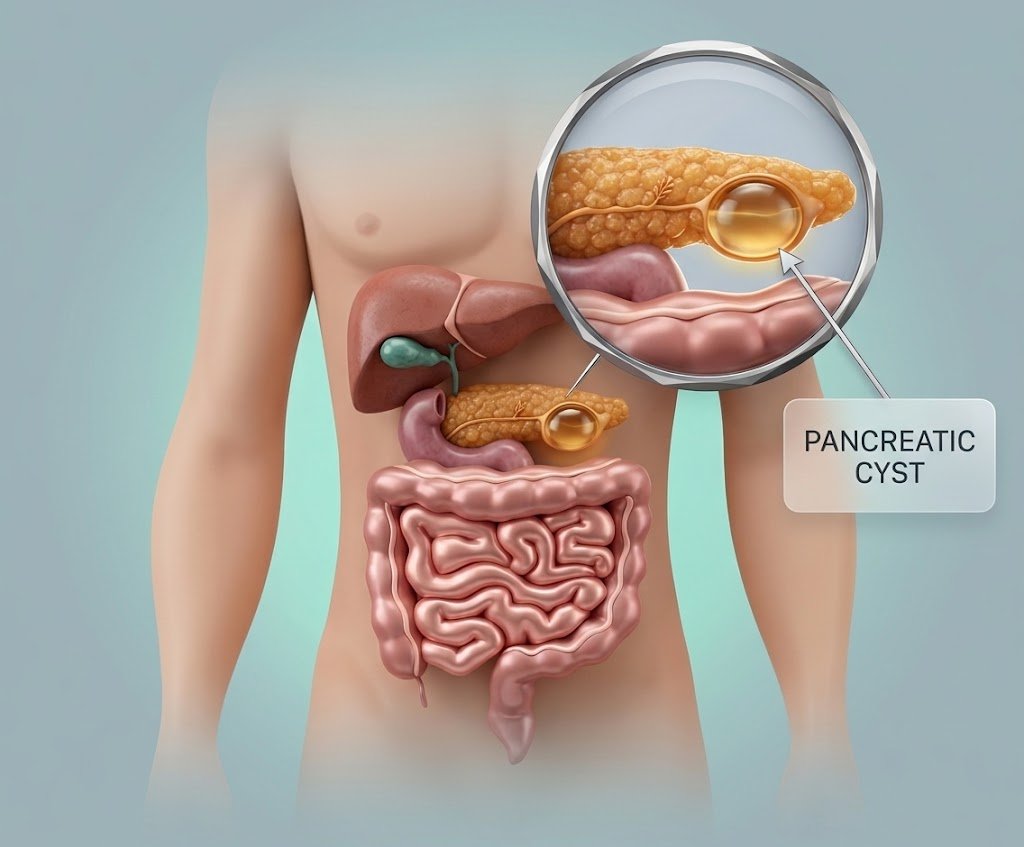
How common are pancreatic cysts?
Quite common! Depending on the population studied, up to 20-30% of adults are found to have at least one small pancreatic cyst on high resolution abdominal scans like an MRI.
Pancreas anatomy and cyst types
The pancreas has several functions, but one of those functions is to manufacture certain digestive enzymes. These pancreatic enzymes are carried through small ‘side branch’ ducts into a larger “main duct'“ which then drains into the small bowel where the enzymes help digestive food. Whether and how a cyst connects to the pancreatic duct system, and what its lining is made of, determines what type of cyst it is and how it is managed. Of the various types of cysts, “pseudocysts” and “serous cystadenomas” are benign. “IPMNs'“ and “MCNs” are the cyst types that warrant attention, but even among these, the large majority never become cancer.
Pseudocyst. This is a benign, walled-off collection of fluid left behind after an episode of pancreatitis. It has no true lining of its own and cannot become cancer. Many pseudocysts may disappear on their own. Treatment/drainage is needed only if it causes symptoms.
Serous cystadenoma. A benign growth, most often seen in women in their 50s-70s, typically with a ‘honeycomb’ appearance on scans. The chance of a serous cystadenoma becoming cancer is negligible. Once our diagnosis is confident, it is usually left alone, and treated only if it grows large enough to press on something.
Intraductal papillary mucinous neoplasm (IPMN). The most common type of pancreatic cyst which carries some precancerous risk. It arises inside the ducts and produces thick mucus. Where an IPMN is located matters: those on a side duct alone are the common, lower-risk form, while those involving the main duct carry a substantially higher risk and are usually removed. A separate information page covers this in detail.
Mucinous cystic neoplasm (MCN). This type of cyst occurs almost exclusively in women, usually in middle age, and almost always in the body or tail of the pancreas. It does not connect to the ducts. It has genuine potential to become cancer over time, so surgical removal is often recommended. Once removed, the cyst needs no further follow-up.
Less common types of pancreatic cysts. Solid pseudopapillary neoplasms and cystic neuroendocrine tumours are quite uncommon and are generally removed when found.
How we diagnose what type of cyst you have
When we discover a panccreatic cyst, the first task is working out which kind of pancreatic cyst is present. A specialized type of MRI called an ‘MRCP’ is our most commonly used test for pancreatic cysts. It shows the ducts clearly, without radiation. CT scan can be an alternative when MRI is not possible.
If the cyst type remains uncertain after imaging, or if something needs a closer look, endoscopic ultrasound (‘EUS’) may be the next step. During EUS, a thin flexible scope with an ultrasound probe at its tip is passed through the mouth into the stomach and duodenum, under sedation, so the pancreas can be imaged from millimeters away. When necessary, a fine needle can be passed through the scope to sample the cyst fluid, which is tested in the laboratory to help distinguish one cyst type from another.
Even with detailed imaging and fluid testing, the cyst type is sometimes not always certain. When that happens, we often take a conservative approach and may monitor the cyst over time by imaging scans.
Does this cyst need monitoring?
This is the question the initial assessment is designed to answer, Not all types of pancreatic cysts need monitoring.
No monitoring needed once the diagnosis is confident — pseudocysts and serous cystadenomas. These cannot become cancer, and there is nothing to watch for. Being discharged from follow-up is the expected outcome, not an oversight.
Monitoring with scans — branch-duct IPMNs and small mucinous cystic neoplasms without concerning features. These have some potential to change, and the scans are looking for that change while it is still early.
Surgery considered from the outset — main-duct IPMNs, most mucinous cystic neoplasms, and the less common tumour types. Here the risk is high enough that removal, rather than watching, is usually the recommendation.
Type not yet certain — sometimes further testing is needed before the cyst can be placed in one of the groups above. In the meantime it is followed as though it were the most likely possibility, not the worst case.
What monitoring involves
For cysts that need following, mostly MRI, at intervals ranging from six months to two years depending on size and character. Larger cysts are checked more often than small ones.
Three things are compared across scans: the size of the cyst and how quickly it is changing, the width of the main duct, and whether any solid nodule has appeared inside the cyst.
How long this continues is a matter on which expert groups genuinely differ. Some recommend stopping after five years of complete stability; others continue for as long as a person would be fit for an operation. It is a reasonable thing to discuss, and the answer depends on the type of cyst, its size, age, and general health. Monitoring is not usually continued in people who would not be well enough for surgery, since it could no longer change what is done.
Findings that would change the plan
Meaningful growth of the cyst
Widening of the main duct
A solid nodule appearing inside the cyst
A thickened cyst wall
Yellowing of the eyes or skin
An episode of pancreatitis
New diabetes, or diabetes that suddenly becomes difficult to control
Any of these prompts closer assessment, usually endoscopic ultrasound, rather than an immediate operation. Several appearing together carries more weight than one alone. Between visits, call about jaundice, unintended weight loss, new diabetes, or severe upper abdominal pain radiating through to the back.
Living with a pancreatic cyst
Most people found to have a pancreatic cyst will have it for the rest of their lives without it ever causing a problem.
A common question is whether diet or other lifestyle changes will alter how a cyst behaves. For the most part, they will not. There is no diet, supplement, or food to avoid that has been shown to change what a pancreatic cyst does, and no reason to make restrictive changes on its own account. The two exceptions are smoking and, to a lesser degree, body weight: both have been linked to a somewhat higher chance of a cyst changing over time. Stopping smoking is worth doing, and keeping to a healthy weight is sensible for the usual reasons. Beyond that, nothing about daily life needs to change.
Mention any family history of pancreatic cancer, and any known inherited cancer gene in the family, since either can change the plan.
Further information
The National Pancreas Foundation maintains plain-language information on pancreatic cysts: pancreasfoundation.org